“I Love You”: Inside the Coogee Beach Shark Attack That Stopped Sydney Cold
Published: 3 Aug 2026
How a mother’s morning swim turned into a fight for her life — and what her recovery reveals about Australia’s summer of sharks
On the morning of Saturday, June 13, 2026, Leah Stewart did something she had done countless times before. She waded into the Pacific at Coogee Beach, one of Sydney’s most beloved stretches of sand, for a swim close to shore. She stayed inside the flagged, lifeguard-patrolled area. She was less than 30 metres from the beach.
Then, without warning, a shark attacked her.
Eleven days later, her brother would post an update that brought people around the world to tears: Leah had briefly opened her eyes, looked at her mother and her partner, and said three words. “I love you.”
This is the story of what happened at Coogee Beach, what is known about Leah Stewart’s condition and recovery, and why her attack landed in the middle of one of the deadliest stretches for shark encounters in Australia’s modern history.
What happened on June 13
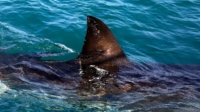
Leah Stewart, a 34-year-old primary school teacher and mother from Coogee, was swimming inside the designated safe-swimming flags when she was bitten by what witnesses and authorities believe was a great white shark, estimated at somewhere between 3.5 and 4 metres (roughly 11 to 13 feet) long. Her daughter, a toddler named August, had been left on the beach in the care of a friend while Stewart swam.
Bystanders and an off-duty lifeguard responded immediately. Accounts describe beachgoers rushing into the water to help pull her to shore, then working together to apply a tourniquet and perform CPR while waiting for paramedics. Emergency crews took her to St. Vincent’s Hospital in Sydney, where she was placed in intensive care on life support.
The injuries were severe. Stewart suffered multiple bites to her arms and legs, extensive lacerations, fractures throughout her body, and massive blood loss. Within days, surgeons amputated one of her arms in an effort to save her life. Over the following week she underwent at least five separate surgeries, with more scheduled in the weeks ahead.
What’s confirmed: The attack occurred inside the swimming flags at Coogee Beach on June 13; Stewart lost an arm and sustained life-threatening injuries; she was placed on life support and underwent multiple surgeries; members of the public helped rescue and stabilize her before paramedics arrived.
What remains less certain: News organizations have reported Stewart’s age as both 34 and 35, and some early reports named a specific lifeguard as her rescuer while others described the helpers more generally as bystanders and an off-duty lifeguard. The exact species and precise size of the shark have not been formally confirmed by authorities, though a great white in the 3.5–4 metre range is the working assumption based on the injuries and witness accounts.
The eleven days that followed
For more than a week, Stewart’s family gave the public only sparse updates through a GoFundMe campaign set up to help cover her medical and rehabilitation costs. It grew quickly — from roughly $300,000 in the days after the attack to nearly half a million Australian dollars by late June — as strangers around the world contributed and left messages of support.
Behind the fundraising numbers was a family standing vigil. Her brother, Joshua Stewart, became the family’s primary voice, posting updates that were by turns clinical and devastating: talk of surgeries, sedation levels, and “a long road ahead.”
Then, on Tuesday, June 23, doctors made a decision that changed the tone of the story. After a week of life support and repeated operations, they extubated Stewart — removing her breathing tube — and reduced her sedation to bring her out of her induced coma for a short period.
For a few minutes, Leah Stewart was awake.
According to her brother, she looked at her mother and her partner, Fernando, who had been at her bedside in intensive care since the attack, and told them she loved them. Her first thoughts, he said, were of her daughter — she wanted to know if August was okay.
Joshua Stewart described the moment as far ahead of anyone’s expectations, calling it something the family had hoped and prayed for. He was careful, though, not to overstate her progress: Stewart remained in critical care, he said, with a long recovery still ahead of her.
By early July, updates suggested Stewart was no longer in a coma and was able to communicate with her family and medical staff, though she continued to face what her brother described as “challenging days” during an extended stretch of surgeries and rehabilitation. He thanked the public for the volume of supportive messages the family had been sharing with her at her bedside.
What’s confirmed: Stewart was brought out of an induced coma on June 23 and spoke to her mother and partner; she asked about her daughter; by early July she was no longer in a coma and could communicate, though remained in a lengthy recovery process.
What’s unknown: Her long-term prognosis, the full extent of her permanent injuries beyond the arm amputation, and a timeline for when — or whether — she will be released from intensive or acute hospital care have not been disclosed publicly. Families in these situations often withhold detailed medical information, and Stewart’s has said as much in asking for privacy alongside their gratitude for support.
A community responds
Coogee is not just a beach; for locals, it is closer to a backyard. Days after the attack, thousands of people gathered there for a community “swim out” — a traditional Australian surf-culture ritual usually reserved for mourning the dead, in which swimmers paddle out together in a circle — held instead in a show of solidarity for a woman still fighting to survive.
That kind of response is not unusual in Australian beach communities after a shark attack, but the scale of it reflected how much Stewart’s story had resonated. She was, by every account from those who know her, an enthusiastic ocean swimmer, a devoted mother, and a well-liked teacher — the kind of ordinary, sympathetic figure whose sudden brush with catastrophe forces a broader public reckoning with a risk most beachgoers spend their lives ignoring.
Why this attack landed differently: the summer Australia couldn’t stop talking about sharks
Stewart’s attack did not happen in isolation. It came in the middle of an unusually violent run of shark encounters across Australia that had already been building for more than a year.
Consider the timeline leading up to June 13, 2026:
- January 18, 2026: A 12-year-old boy, Nicolas “Nico” Antic, died days after being attacked by a suspected bull shark while jumping off rocks in Sydney Harbour, near Vaucluse. The attack was one of several reported in Sydney waters within a 24-hour span that prompted the closure of dozens of beaches across the city.
- May 16, 2026: A diver was seriously injured by a shark while spearfishing off Rottnest Island, Western Australia.
- May 24, 2026: A 39-year-old spearfisherman, Michael Jensz, was killed by a shark at Kennedy Shoal off Cairns, Queensland, while diving with friends from a boat.
- June 6, 2026: A diver in his thirties was killed by an estimated 15-foot shark while spearfishing off Michaelmas Island, southeast of Perth — Australia’s fourth fatal shark attack of the year at that point, and the second in Western Australia alone.
- June 13, 2026: Leah Stewart is attacked at Coogee Beach, Sydney.
That cluster followed an already grim 2025, a year in which Australia recorded roughly five fatal shark bites — making it, by some counts, the deadliest country in the world for shark-related deaths that year. Among the dead: 57-year-old surfer Mercury Psillakis, killed off Sydney’s Long Reef Beach in September 2025 in an attack witnessed by beachgoers.
Marine scientists cited across multiple reports have pointed to two converging factors behind the apparent rise in incidents: warming ocean temperatures, which appear to be shifting the migratory patterns of sharks and the prey they follow closer to popular beaches, and simply more people in the water than ever before — Australians made an estimated 650 million coastal visits in a single recent year, according to a national survey.
It’s worth being precise about what that means and doesn’t mean. Unprovoked shark bites remain statistically rare relative to the number of people swimming, surfing, and diving in Australian waters every year. But the frequency of serious and fatal incidents in 2025 and 2026 was high enough, and public enough, that it reopened long-running debates in Australia over shark nets, drone surveillance, and how much protective infrastructure is realistic or effective on beaches that stretch for thousands of kilometres.
Coogee Beach itself has for years used a combination of shark-spotting drones and, at times, warning signage to alert swimmers when the technology detects a shark in the area — the same system that was in place, and visible in photographs from the beach, in the days following Stewart’s attack.
What’s disputed or still being studied: Exactly how much of the increase in shark attacks is attributable to climate-driven changes in shark behaviour versus simply more swimmers in the water is a question marine biologists are still working through; both factors are widely cited, but neither has been established as the dominant single cause.
The bigger picture: what Leah Stewart’s story is really about
It would be easy to read this as simply a shark-attack story — dramatic, frightening, resolved by a hopeful headline about a woman saying “I love you.” But the fuller picture is more complicated and, in some ways, more human.
It’s a story about how quickly an ordinary Saturday can turn catastrophic, and how a community of strangers — first the people on the beach who didn’t hesitate to help pull a bleeding woman from the water, then hundreds of thousands of people online who contributed to a fundraiser and a public swim of solidarity — can meaningfully change the trajectory of someone’s recovery.
It’s a story about the limits of what we can control in nature, set against a backdrop of genuine scientific concern about how warming oceans are changing the behavior of one of the world’s most feared predators, and how that intersects with a coastline where hundreds of millions of people choose to swim every year anyway.
And it’s a story, still unfinished, about a mother whose first words after eleven days of induced unconsciousness were about her daughter and the people she loves — a small, human detail in a summer defined by loss, that gave an entire country, at least for one week in June, a reason for hope instead of grief.
As of the most recent public update from her family in early July, Leah Stewart remained in recovery, facing more surgeries and a rehabilitation process her brother has described as long and, at times, difficult. Her family has continued to ask supporters for patience and privacy even as they express gratitude for the outpouring of public support — a reminder that for the Stewart family, this is not yet a story with an ending.
Sources
This article draws on reporting and public updates from AFP/CTV News, the Sydney Morning Herald, The Guardian, ABC Australia, The Nightly, The Inertia, Fox News, Newser, Malay Mail, the Australian Shark-Incident Database (via Wikipedia’s List of fatal shark attacks in Australia), CBS News, and public statements posted by Joshua Stewart on the GoFundMe campaign established for his sister, Leah Stewart.
He Went Missing in a Canadian Wilderness With Grizzlies, Wolves, and No Cell Signal. Fifty Days Later, Two Strangers Found Him Walking Down a Dirt Road.


- Be Respectful
- Stay Relevant
- Stay Positive
- True Feedback
- Encourage Discussion
- Avoid Spamming
- No Fake News
- Don't Copy-Paste
- No Personal Attacks
- Be Respectful
- Stay Relevant
- Stay Positive
- True Feedback
- Encourage Discussion
- Avoid Spamming
- No Fake News
- Don't Copy-Paste
- No Personal Attacks
