Adrift: The 44 Days Kai Sato Spent Fighting to Stay Alive on the Pacific
Published: 29 Jul 2026
The Sighting
Nine hundred miles from Hawaii, in a stretch of ocean where cargo ships pass but small boats almost never do, a watch stander aboard a container ship called M/V George III spotted something that didn’t belong. It was a sailboat. Or what was left of one.
Its mast was gone, snapped clean off weeks earlier. Its sails had been replaced with a strange, improvised rig made of PVC pipe and kayak paddles. There was no engine noise, no radio call, no obvious sign of life — just a battered 32-foot hull rising and falling with the swells, drifting in the middle of nowhere. Then a figure appeared on deck, waving.
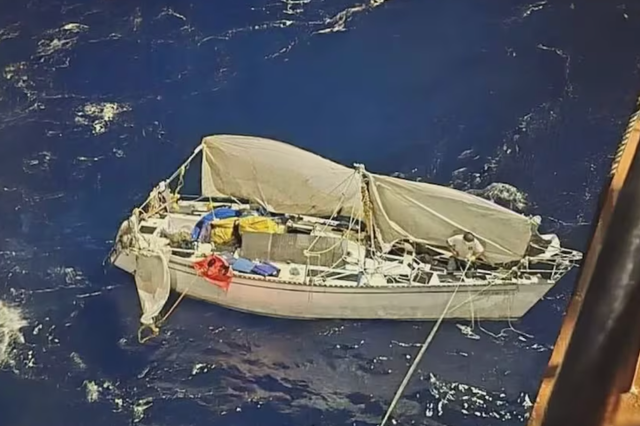
For more than a month, that man had been alone out there, watching the horizon for exactly this moment. He had run out of gas. He had run out of water. He had, by his own account, come close to giving up entirely. Now a massive container ship was slowing down, its crew scrambling to rig a ladder and throw a line to a stranger they’d never met.
Who was he? How long had he been out there? And how does a person survive more than a month adrift in the open Pacific with no engine, no sail, and almost no supplies?
The answers trace back six weeks, to a sunny June morning off the California coast, when a 39-year-old sailor named Kai Sato set out to do something he had never done before.
Rewind: A First Solo Voyage
Kai Sato, formally Kaichi Sato, is a 39-year-old sailor from California who, according to reporting from Hawaii News Now and NBC Los Angeles, had never before attempted to sail solo across the open Pacific. This trip — Catalina Island to Hawaii — was meant to be his first.
Sato wasn’t a stranger to this particular crossing. He’d made the trip once before, as a boy, sailing alongside his uncle on a previous voyage from California to Hawaii. That memory would matter more than he could have known.
On June 7, Sato left the waters near Catalina Island aboard his 32-foot sailboat, pointed west, and began the long crossing alone. (A statement later released by the Seafarers International Union described his starting point slightly differently, saying he sailed out of Long Beach; the discrepancy is minor and doesn’t change the substance of what followed.)
Solo ocean crossings are, by nature, a bet against the weather, the equipment, and one’s own body. Sailors who attempt them typically spend months preparing routes, provisions, and backup plans, because there is no towing service in the middle of the Pacific and no cell signal to call for help. For the first stretch of Sato’s journey, the bet seemed to be paying off. The weather held. The boat performed. He was, by all accounts, making real progress toward Hawaii.
Then, according to Sato’s own account given to Hawaii News Now, the weather turned violent — and his boat’s mast snapped.
The Inciting Event: A Broken Mast, a Sitting Duck
A sailboat without a mast is, in the most literal sense, no longer a sailboat. The mast is what holds the sail; without it, wind becomes useless, and a boat is reduced to whatever engine power it has left — if any.
Sato tried to motor back toward shore. It didn’t work. He ran out of gas before he could get anywhere close to land or a shipping lane.
“I was literally like a sitting duck, just getting taken south by the current going way off course,” Sato later told Hawaii News Now.
He described crying for a week straight, drifting further off course with no way to steer and no way to call for help. In an admission that underscores just how dire the situation became, Sato told reporters that in that first devastating week, he considered ending his own life rather than face what lay ahead.
It’s a sobering detail, and one worth pausing on—not to sensationalize it, but because it’s central to understanding what came next. Somewhere in the depths of that despair, something shifted. After five days of what he described as contemplation, Sato said he “sprang into action.”
The central question of the story was no longer will he be rescued — it was can a man alone, with a broken boat and almost nothing left, keep himself alive long enough to be found at all?
The Long Drift: Jerry-Rigging, Rationing, and Talking to the Wind
What followed was roughly a month of survival engineering, played out entirely alone on open water.
The rig. Without a mast, Sato improvised. Using PVC pipes and kayak paddles — materials that happened to be aboard — he rebuilt a crude sail system capable of catching enough wind to steer, even if not to sail at full strength. It was enough, over time, to begin nudging the boat back north, toward the commercial shipping lane that runs between California and Hawaii. Sato said it took roughly a month of slow, grinding progress to get there.
Each new question demanded its own workaround. Could he steer without a mast? Barely — with pipes and paddles. Could he survive without reaching land? Only if he could solve the next problem, and the one after that.
The water crisis. On July 11, more than a month into the ordeal, Sato’s drinking water ran out entirely. His solution was almost primitive in its simplicity: he filled buckets with seawater, stretched plastic bags over the top, and let the sun’s heat evaporate the water inside, collecting the condensation that formed on the plastic — a crude but functional solar still. It produced only a trickle at a time.
“I was just licking that to survive,” Sato said of the process.
The food. With no supplies left to speak of, Sato said his diet became whatever the ocean provided: oatmeal he still had on hand, supplemented by fish and squid that occasionally ended up on the boat.
The mind. Perhaps the least visible survival tool was psychological. Sato has described calling out for guidance, meditating, and talking to the wind and the water during the weeks alone. He also said he felt the presence of his uncle — the same uncle who had sailed this exact California-to-Hawaii route with him when he was young. Whether that presence was memory, imagination, or something Sato experienced as more than either, it’s not something a journalist can verify. What is documented is that Sato has said it helped him keep going.
Each fix bought him more time. Every extra day, though, raised the same unanswered question hanging over the entire ordeal: would he reach the shipping lane — the only realistic chance of rescue — before his body or his boat gave out first?
The Twist: Help Was Closer Than It Looked, and Further Than He Feared
For weeks, Sato’s entire survival strategy hinged on one gamble: reaching the shipping lane used by cargo vessels traveling between the U.S. West Coast and Hawaii. It was his only plausible path to rescue, since he had no working radio communication described in any of the reporting and no way to send a distress signal beyond visual sighting.
Here is where the story complicates itself. Public accounts of exactly when Sato’s mast snapped don’t fully agree. Hawaii News Now’s initial reporting quoted Sato saying the break happened “nearly two weeks” into the June 7 departure — which would place it in mid-to-late June. A separate statement from the Seafarers International Union, describing the same voyage, put the mast failure on July 20, just one day before the rescue. The two accounts can’t both be literally correct, and neither NBC Los Angeles nor Hawaii News Now has published a correction reconciling them. What’s undisputed is the broader timeline: Sato departed June 7, and was rescued on July 21 — a span of 44 days, the bulk of which he spent disabled and adrift.
That distinction matters less for the emotional shape of the story than it might seem. Whether the mast broke in June or in July, the outcome was the same: Sato spent weeks navigating a barely functional boat back toward a shipping lane that offered no guarantee any ship would actually pass close enough to see him — let alone in time.
The twist readers might not expect is this: after all that engineering and endurance, the actual rescue took under two hours. Once his makeshift boat drifted into view of a passing ship, everything that had taken weeks to arrange — the improvised sail, the solar still, the slow crawl north — became irrelevant in the space of 90 minutes.
The Climax: Ninety Minutes That Ended a Six-Week Ordeal
On Tuesday, July 21, watch standers aboard the M/V George III — a Jones Act container vessel operated in Pasha Hawaii’s service and crewed by members of the Seafarers International Union — spotted Sato’s disabled sailboat roughly 900 miles from Hawaii.
According to a statement from the Seafarers International Union, “all hands were called to assist in the recovery of solo sailor Kaichi Sato aboard his de-masted 32-foot sailboat.” The ship’s crew went into a coordinated response: engineers prepared the engines for careful, close-quarters maneuvering; deck crew rigged a pilot ladder, life rings, and line-throwing equipment; and additional crew members helped guide the much larger vessel toward the tiny boat without endangering either craft.
It reportedly took two attempts before Sato was able to climb the rope ladder onto the ship. In total, from the moment the crew first sighted his boat to the moment he was safely aboard, the recovery took approximately an hour and a half.
Sato described the moment in visceral terms: “Oh my God, yeah, like ecstatic, you know what I mean? Like I was like crying and like so happy, and then they got me fruit and water, and yeah, they were so good to me, those guys.”
The ship’s crew gave him a private suite to rest in, along with fresh clothes and food — small comforts that, after 44 days of oatmeal, seawater, and isolation, must have felt enormous. Captain Eric Veloni, the vessel’s master, later credited his crew’s professionalism and speed in carrying out the rescue, according to the union’s statement.
The central question that had driven the entire ordeal — would he be found before it was too late — was finally answered. He was found. He was alive. And he was, by multiple accounts, in reasonably good physical condition given what he’d endured: dehydrated and emotionally exhausted, but not in critical medical danger.
Aftermath: What Comes After Surviving the Ocean
Sato has since reunited with relatives in Hawaii and, according to reporting, has been staying with family before checking into a hotel as he processes the experience. He has publicly and repeatedly thanked the crew of the George III for saving his life.
Remarkably, the ordeal hasn’t turned Sato away from sailing. He has told Hawaii News Now that he’s already planning his next solo voyage — this time to the Philippines, and in a larger boat.
What remains unresolved is mostly texture rather than substance: the exact date his mast failed, the precise sequence of his psychological low point, and how, exactly, a man alone on a disabled boat found the will to keep improvising for six weeks rather than give up. Those are questions only Sato himself can answer in full, and so far, public reporting has only scratched the surface of his account.
What is confirmed, and what makes this story resonate beyond a single news cycle, is simpler: a man set out to do something difficult and new, faced a genuine crisis of survival and of spirit, and made it through — not because rescue came quickly, but because he kept solving one problem at a time until rescue came at all.
This story touches on a sensitive topic — suicidal thoughts during a moment of crisis. If you or someone you know is struggling, the 988 Suicide & Crisis Lifeline (call or text 988 in the U.S.) offers free, confidential support 24/7.




- Be Respectful
- Stay Relevant
- Stay Positive
- True Feedback
- Encourage Discussion
- Avoid Spamming
- No Fake News
- Don't Copy-Paste
- No Personal Attacks
- Be Respectful
- Stay Relevant
- Stay Positive
- True Feedback
- Encourage Discussion
- Avoid Spamming
- No Fake News
- Don't Copy-Paste
- No Personal Attacks
