Buried Alive for Eight Days: The Security Guard Who Refused to Let His Wife Say Goodbye
Published: 29 Jul 2026
How a night-shift guard survived under 140 tons of collapsed concrete — and why the man who found him almost didn’t tell anyone he was still breathing.
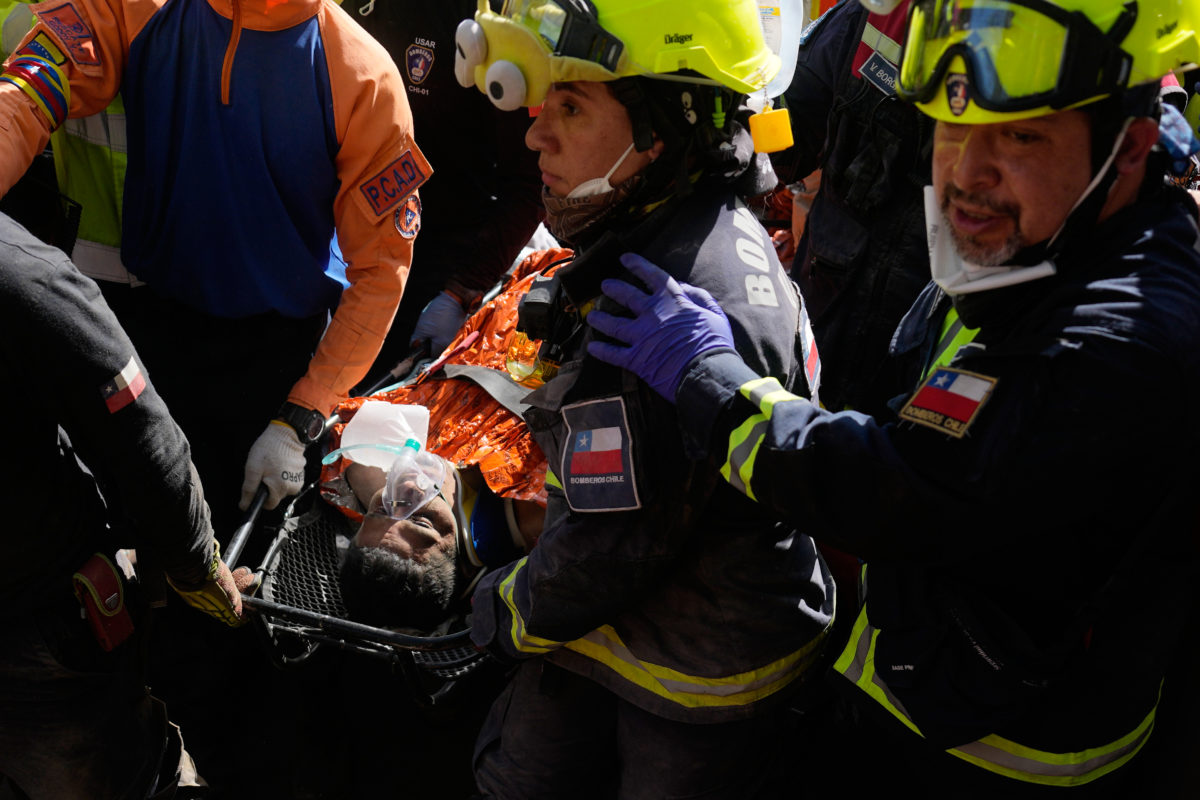
Rescuers had stopped expecting to find anyone alive.
It was day five after the earthquakes, and the Galerías Playa Grande shopping center in Catia La Mar, Venezuela, had folded in on itself like a house of cards. Teams from six countries had been combing the wreckage since the first night, and by now the operation had quietly shifted, the way these things always do, from rescue to recovery. Nobody says that out loud. Everyone understands it anyway.
Then, on a Sunday morning nearly a hundred hours after the ground first shook, a rescuer from the Costa Rican Red Cross climbed onto a slab of broken concrete, cupped his hands, and called into a gap in the debris — more out of habit than hope.
“Is anyone alive?”
A voice came back.
It belonged to a 43-year-old security guard who had been sealed inside a small booth in the mall’s underground parking structure since the moment the building came down around him. He had been buried for four days already, and he would remain there for four more — trapped under wreckage so unstable that the building above him kept shifting, millimeter by millimeter, while rescuers worked.
And when they finally reached him, the first thing he asked for wasn’t water. It was a promise.
Rewind and Setup
To understand why one man’s survival became a moment the whole country needed, it helps to understand what Venezuela had already been through in the week before anyone knew his name.
On the evening of June 24, 2026, at around 6:04 p.m. local time, the ground beneath northern Venezuela ruptured twice within 39 seconds. The U.S. Geological Survey recorded a magnitude 7.2 earthquake near San Felipe in Yaracuy state, instantly followed by a magnitude 7.5 event centered nearby — the strongest earthquake to strike the country in more than a century. Seismologists call this rare pairing a “doublet”: two nearly identical quakes, similar in depth, waveform, and strength, striking the same fault system in rapid succession. It meant that buildings already shaking from the first jolt had no time to recover before the second, far stronger one hit.
The damage was immense and immediate. Tens of thousands of structures across northern Venezuela were damaged or destroyed. La Guaira, the coastal state that includes Catia La Mar and sits beside the country’s main seaport and international airport, was hit hardest of all. Within days, the confirmed death toll climbed past 1,000, then past 2,000, with more than 11,000 people injured and tens of thousands still unaccounted for. United Nations officials warned the toll would keep rising as crews reached areas that had been cut off. It landed on a country already worn down by years of economic and political crisis, and complicated further by a heavily restricted media and internet environment that made it harder for families abroad to learn whether loved ones had survived.
Among the buildings that came down was the Galerías Playa Grande shopping center. Inside its underground parking garage, working the night shift as he always did, was a security guard named Hernán Alberto Gil Flores.
When the first tremor hit, he was in his post — a small guard cabin built to withstand daily wear, not an earthquake. Then everything changed.
The Inciting Event
The concrete above and around him gave way. Floors that had held shoppers’ cars for years buckled and dropped. By any reasonable expectation, Gil Flores should not have survived what happened next.
But his cabin held.
The small structure that housed his guard post did not collapse the way the rest of the building did. It stayed intact, wedged inside a landscape of crushed concrete and twisted rebar, and in doing so it created something rescuers would later call a vital pocket of air — a tiny, stubborn space that kept him alive while the rest of the mall fell down around him.
He was alone, in the dark, under what search teams would later estimate was more than 140 tons of debris. He had no way of knowing whether anyone above him had survived, whether help was coming, or whether anyone even knew he was down there at all.
This is where the story’s central question takes shape: in a disaster zone with thousands of victims and a shrinking window for rescues, would anyone find one man buried beneath a collapsed parking garage — and if they did, would they reach him in time?
Most search-and-rescue operations work from a grim but practical rule of thumb: the odds of finding survivors drop sharply after 48 to 72 hours. Gil Flores would end up buried for roughly eight times that long.
The Investigation / Journey
For the first several days, nobody knew he was there.
Rescue crews were stretched across an enormous disaster zone, working site after site with dogs, thermal cameras, and listening equipment, prioritizing locations where people were known or believed to be trapped. The Galerías Playa Grande site was one of many. Teams from Chile, the United States, Portugal, Mexico, El Salvador, Costa Rica, and Venezuela itself were coordinating search efforts nationwide, often working around the clock in the rain, through recurring aftershocks, and atop structures that could shift again at any moment.
Then came the first real break: a voice, where no one expected one.
On Sunday, June 29 — roughly 100 hours after the earthquakes struck — a specialized team from the Costa Rican Red Cross was working the site when a rescuer named Allan Madrigal called into the rubble. He got an answer. A brief, almost businesslike exchange followed, confirming that someone was alive down there and that he was not crushed, simply sealed in.
That answer solved one question and immediately created two more: How badly injured was he? And could rescuers physically reach him without bringing the rest of the unstable structure down on top of him?
The formal extraction effort began the next morning, June 30, and quickly turned into one of the most technically difficult rescues of the entire disaster response. The neighboring section of the building was shifting at a rate that at times accelerated ninefold, and the parking structure itself had moved several centimeters since the quake — meaning the ground rescuers were tunneling through was not stable ground at all, but a slowly moving hazard. Persistent aftershocks and torrential rain added to the danger, threatening to collapse the very passage crews were carving toward him.
Rescuers fed a telescopic camera through the narrowing gaps to keep visual contact and pass materials down a shaft too small for a person. Through it, they sent water and liquid nutrition, keeping Gil Flores alive and reasonably lucid as the excavation crawled forward hour by hour. A Chilean firefighter named María Paz Campos became his main point of contact during the final stretch, talking him through the process, keeping him calm, and issuing him small, practical instructions — at one point telling him to keep on a pair of protective goggles so falling debris particles wouldn’t get into his eyes.
In footage released by Chilean fire crews shortly before the rescue, Gil Flores can be seen passing the time by drawing — an oddly calm image from inside a space most people could not imagine surviving an hour in, let alone eight days.
Every discovery brought a new complication. Rescuers confirmed he was alive — then had to confirm he could be reached at all. They found a path toward him — then had to stabilize it against a structure still actively moving. They kept him fed and hydrated — then had to figure out how to physically extract a man from a space collapsing more each day, without the final effort being the thing that brought it down entirely.
The Twist
About midway through the extraction effort, rescuers learned something that reframed the entire operation — not about the building, but about the man inside it.
When Costa Rican Red Cross rescuer Minyar Collado’s team made contact with Gil Flores, he didn’t ask them to hurry, and he didn’t ask them to call his family. Instead, he made a specific, painful request: if he didn’t make it out, he didn’t want his wife told he had been alive at all.
It’s a small detail, easy to miss in the flood of information about tonnage and instability and international coordination — but it changes how the entire ordeal reads. This wasn’t simply a man waiting to be rescued. It was a man who, after days alone in the dark, had already made peace with the possibility that this could end badly, and who was trying, even then, to protect the people he loved from false hope.
Collado’s team didn’t take him up on it. “We were never going to leave him here,” she later told The Associated Press.
Meanwhile, above ground, his wife, Gusbimar González, had spent days not knowing whether her husband was alive, dead, or simply unaccounted for in the chaos — one uncertainty layered on top of another. The couple has two children, ages 8 and 10. When word finally reached her that rescuers had made contact, she described the moment in stark terms: she said she saw “a ray of light in the darkness.”
The twist here isn’t a plot reversal in the traditional sense. It’s a shift in what the story is actually about. What looked like a technical, engineering-driven rescue mission was, underneath, also a story about a man managing his own possible death from inside a collapsed building — and a family on the surface bracing for the worst while refusing to give up hope.
The Climax
By Thursday, July 2 — eight days after the earthquakes first struck — the excavation had finally reached him.
Rescuers carefully freed Gil Flores from the space that had both trapped him and kept him alive, placing him on a stretcher, an oxygen mask over his face, a tarp shielding him as they carried him out through the wreckage. Outside, crews from multiple countries who had spent more than 72 hours on this single extraction erupted — cheering, embracing, some visibly in tears. Members of the Costa Rican Red Cross team laughed in open relief. Others simply applauded.
He was loaded into a Red Cross ambulance and taken for medical evaluation, eight days after walking into work for what should have been an ordinary night shift.
The rescue was quickly described by officials and rescue workers as one of the most remarkable saves of the entire disaster response — a survival timeline roughly eight times longer than the window search-and-rescue teams typically consider realistic. It didn’t undo the scale of the tragedy around it. But for the exhausted teams who had spent more than a week pulling mostly bad news out of the rubble, it was proof that a good outcome was still possible.
The Aftermath
Gil Flores survived. His wife and children got the outcome he had been afraid to hope for out loud. The international rescue teams who had spent days on that single site — some of the same crews who had been working other locations with far grimmer results — got to end at least one operation with cheers instead of silence.
But his rescue didn’t end the disaster it came out of. As of the most recent official figures, the twin earthquakes had killed more than 2,200 people and injured over 11,000, with tens of thousands still displaced and aid organizations warning of overwhelmed hospitals and the risk of disease spreading through crowded shelters. Some official casualty figures have also been publicly disputed, with discrepancies reported between government tallies and independent estimates — a reminder that even the basic scope of the disaster remains difficult to pin down with total precision.
What’s confirmed is straightforward: a security guard was trapped for eight days, an international rescue effort found him and got him out alive, and his survival became one of the singular hopeful moments in a national tragedy. What’s still unfolding — the final death toll, the long-term recovery of La Guaira and the rest of northern Venezuela, the fate of tens of thousands of damaged or destroyed homes — will take much longer to resolve than eight days.
For now, there is at least one clear ending: a man who asked rescuers to keep a secret from his wife, in case the worst happened, got to go home and tell her himself instead.



- Be Respectful
- Stay Relevant
- Stay Positive
- True Feedback
- Encourage Discussion
- Avoid Spamming
- No Fake News
- Don't Copy-Paste
- No Personal Attacks
- Be Respectful
- Stay Relevant
- Stay Positive
- True Feedback
- Encourage Discussion
- Avoid Spamming
- No Fake News
- Don't Copy-Paste
- No Personal Attacks
