He Felt the Floor Disappear Beneath Him. Then a Medal That Should Have Been Lost Forever Turned Up in His Pocket.
Published: 31 Jul 2026
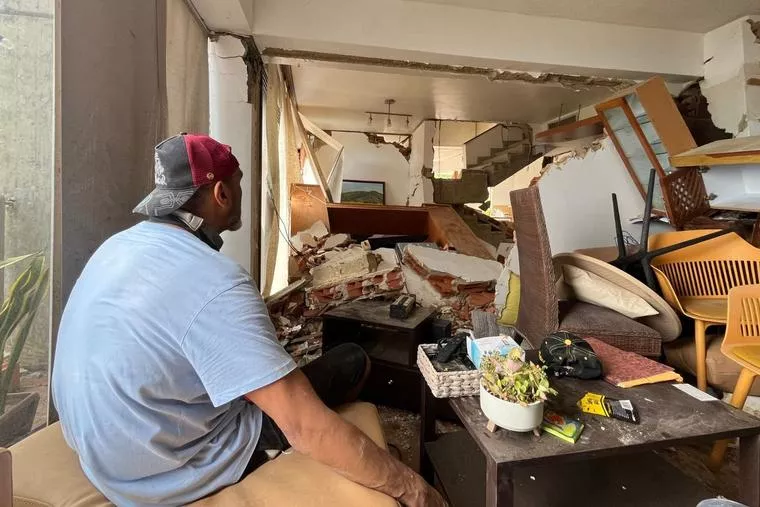
At 6:05 p.m. on June 24, 2026, Kamar Galíndez was standing in a gym on the top floor of a beachfront hotel in Venezuela, about to start his workout. Then the machines around him began sliding across the floor like pucks on an air hockey table.
Seconds later, the section of the building he stood in gave way and dropped straight down.
“The floor split, and immediately I saw half the building tilting forward while the section I was in collapsed straight down,” he would later recall. “I felt my feet were no longer standing on anything, and the next thing I knew, I was trapped in the rubble.”
He was buried under a mountain of concrete, twisted metal, and dust, a massive beam pinning his chest so tightly he could barely draw breath. His left arm was shattered. Around him, in the dark spaces between the wreckage, he could hear other people screaming for help.
He had no way of knowing it yet, but the building he’d just been swallowed by would become one small piece of a catastrophe that, within weeks, would kill thousands of people across an entire country. And he had no way of knowing that a small silver medal, torn from a chain around his neck sometime during the collapse, was about to turn up somewhere it had no business being.
Galíndez survived. What happened to that medal is the part of his story he can’t explain — and the part he says he’ll never stop talking about.
An Ordinary Holiday Evening in La Guaira
To understand why this moment mattered so much to Galíndez, it helps to understand what an entirely unremarkable evening this was supposed to be.
Galíndez, a 53-year-old lawyer, was staying at Chipi’s Beach Hotel in Playa Grande, a seaside neighborhood in the coastal city of La Guaira, Venezuela. La Guaira sits just north of Caracas, the capital, hugging the Caribbean coastline — the kind of place where hotel guests go up to rooftop gyms in the early evening specifically because the ocean view is worth the climb.
June 24 was a Wednesday, and it wasn’t a day off by accident. It’s a national holiday in Venezuela, marking the anniversary of the Battle of Carabobo, one of the decisive battles of the country’s war for independence in 1821. It’s also the feast day of St. John the Baptist on the Catholic calendar — a detail that would later feel significant to Galíndez, a man who says his Catholic faith, and in particular his devotion to the Virgin Mary through the Miraculous Medal, has anchored him for years.
That devotion traces back nearly two centuries, to a French convent in 1830, where a young novice named Catherine Labouré reported seeing the Virgin Mary in a chapel vision. According to that account — now a well-known part of Catholic devotional history — Mary asked that a medal be struck in a particular design, promising that <cite index=”16-1″>those who wore it around their necks with confidence would receive great graces</cite>. The medal became so associated with answered prayers and reported protection that people simply started calling it the Miraculous Medal, and the name stuck. It’s one of the most widely worn sacramentals in the Catholic world today, small enough to disappear into a shirt collar or a coin pocket — which is exactly where this story is headed.
None of that history was on Galíndez’s mind at 6:04 p.m. that evening. He was just a man finishing his day, heading up to exercise before dinner. Then the ground under Venezuela’s northern coast tore itself apart.
Two Earthquakes, Thirty-Nine Seconds Apart
What Galíndez felt was not one earthquake but two, arriving back to back. Seismologists later confirmed a magnitude 7.2 earthquake struck first, centered near Yumare in Yaracuy state, followed roughly <cite index=”7-1″>39 seconds later by a far more powerful magnitude 7.5 mainshock centered off the coast near La Guaira</cite>. It was, by multiple measures, <cite index=”4-1″>the strongest earthquake to hit Venezuela in more than a century</cite>.
The damage was staggering and immediate. In La Guaira state alone, <cite index=”4-1″>roughly 80% of buildings collapsed</cite>. The U.S. Geological Survey’s automated damage-assessment system, which estimates casualties within minutes of a major quake using population density and building data, issued its most severe possible alert level for both events — and its early models warned that <cite index=”4-1″>the true death toll could end up running past 10,000</cite>, far higher than the numbers Venezuelan officials were confirming in the first days.
For Galíndez, none of the science mattered in that moment. All that mattered was that the hotel gym floor had opened underneath him, and he had gone from standing upright to buried alive in the span of a few seconds. The question that would define the next stretch of his life had already been asked, without a single word: would he get out?
Buried, Broken, and Praying to Stay Calm
Galíndez never lost consciousness — a detail he mentions almost with disbelief. He felt every impact of the collapse. But he also noticed something else: once the shock set in, physical pain became strangely secondary to the sheer effort of staying alive.
His head, by chance, had not been buried. Looking up through the wreckage, he could still see a sliver of sky, lit by the day’s last light. That small window to the outside world became his anchor. Around him, the sounds of other trapped people crying out confirmed what he already suspected — this wasn’t an isolated accident. Something enormous had just happened.
He tried to move and discovered his left arm was broken. Fear took over — by his own account, “a lot of desperation, a lot of fear.” But instead of panicking further, he did something that would define how he processed the entire ordeal: he prayed. Not elaborate prayers, but short, direct ones. Stay calm. Tell me what to do next.
As the building came down around him, his mind had gone to a specific image from his faith: the depiction of Jesus as the “Divine Mercy,” based on the visions reported by a Polish nun, St. Faustina Kowalska, in the early 1930s. He repeated a single request: Lord, have mercy.
He signaled for help however he could manage with a crushed chest and a broken arm. He has no idea how long he was trapped — only that it felt endless. Eventually, a stranger climbed the debris field toward him and helped pull him free.
That should have been the end of the dramatic part of his story. It wasn’t.
The Detail That Doesn’t Add Up
Galíndez made it down off the ruined building under his own power. As he moved toward what was left of his own home — also destroyed in the quake — he began to grasp the scale of what had just happened, a disaster that would ultimately be measured in thousands of lives. He is convinced that walking away from it relatively intact was not luck. He credits it to Our Lady of the Miraculous Medal, a devotion he had practiced for years.
Here’s the detail that makes this more than a general expression of gratitude: Galíndez says he had been wearing a small chain around his neck that day, with a crucifix and a small Miraculous Medal on it. Sometime during the collapse — he has no memory of exactly when — that chain broke and came off his body entirely. In the chaos of the wreckage, he assumed it was simply gone, lost forever somewhere in the rubble, one more small casualty of the disaster.
A couple of young bystanders reached him as he made his way home and began giving him first aid. At one point, he asked them to help remove his watch and tuck it into a small zippered pocket on his shorts, since he needed his good hand free to hold his broken arm steady.
That’s when, in his words, “the inexplicable happened.”
A Broken Chain, a Zippered Pocket, and No Explanation
When the pocket was opened to put the watch away, the medal and a piece of the broken chain were already inside it.
Not draped around his neck. Not sitting loose in the wreckage. Inside a small zippered pocket on a pair of shorts — a pocket that, by his account, he hadn’t opened or touched since before the earthquake struck.
“I was wearing shorts with a small zippered pocket, and when I looked — don’t ask me where from, don’t ask me how — a piece of the chain and the Miraculous Medal were caught inside,” Galíndez said. In the moment, still in shock and being treated for a fractured arm, he asked the young man helping him to carefully set the medal aside too. “That was what saved me,” he told him.
To be clear about what can and can’t be verified here: there is no independent forensic account of exactly how or when the medal ended up in that pocket. Galíndez is the sole witness to the sequence of events, recounting it from memory in the aftermath of a life-threatening trauma. It’s entirely possible there’s a mundane physical explanation — the chain catching on his clothing during the fall, or during his own movements as he tried to free himself, funneling into the pocket by chance in the chaos of the collapse. That is speculation, not a confirmed account, and no one, including Galíndez, claims to know for certain. What is confirmed is that he wore the medal that day, that the chain broke during the collapse, and that the medal was later found inside that pocket. The interpretation — that this was a small miracle rather than a physical coincidence — is Galíndez’s own belief, rooted in his Catholic faith, not an established fact.
For him, though, there was no ambiguity at all. “Absolutely, absolutely,” he said, when asked directly whether he believes his survival was owed to Mary’s intercession. “I haven’t the slightest doubt.”
Why One Man’s Medal Matters in a Story This Big
It would be easy to treat this as a small, strange footnote — one man’s personal object turning up somewhere unexpected during an emergency. But the reason it resonates has less to do with the medal itself and more to do with the scale of what it survived alongside.
The twin earthquakes that struck Venezuela on June 24 killed people by the thousands, not the dozens. In the first days after the disaster, officials reported <cite index=”8-1″>1,719 confirmed deaths, with roughly 5,000 more injured and about 12,000 people displaced</cite>. Within a week, that toll had climbed to <cite index=”6-1″>1,943 dead and more than 10,500 injured</cite>. By early July, the figure passed <cite index=”9-1″>3,500 deaths, with nearly 18,000 people left without housing</cite> and thousands sheltering in dozens of makeshift camps across Caracas and La Guaira. By late July, independent trackers put the confirmed toll at <cite index=”4-1″>more than 5,500 dead and 16,700 injured, with tens of thousands still unaccounted for</cite> — and the USGS’s early computer models had already warned the real number could be dramatically higher still.
Complicating the picture further, Venezuela is one of the most restricted media environments in the world, and in the days after the quake, <cite index=”3-1″>more than 200 websites — including news outlets, social media platforms, and censorship-circumvention tools — remained blocked inside the country</cite>, making it harder for families abroad to learn what had happened to loved ones and for outside observers to independently verify official casualty figures. The United Nations’ fact-finding mission on Venezuela specifically <cite index=”3-1″>urged authorities to restore access to social networks and media outlets</cite>, arguing that reliable information was, in itself, a matter of life and safety in the aftermath.
International aid poured in anyway. The United States deployed search-and-rescue teams from Virginia and Los Angeles within a day of the quake, according to public statements from U.S. officials, and organizations like World Vision moved into hard-hit neighborhoods — including Playa Grande, the very neighborhood where Galíndez’s hotel stood — to provide emergency food, water, and psychological support to survivors.
Against that backdrop, a single lawyer’s account of a medal in a pocket is a small story. But it’s also representative of something bigger: in a disaster this overwhelming, in a country where trustworthy information itself was hard to come by, individual survivors’ stories — verifiable in their broad strokes even when their most personal details can’t be independently confirmed — became one of the only ways the outside world could understand what people on the ground were actually living through.
What Remains Unknown
Several things about this story are firmly documented: the earthquakes themselves, their magnitude and timing, the catastrophic death toll, and the broader humanitarian response are all confirmed by seismological data, government statements, and independent journalism. Galíndez’s identity, his hotel, his injuries, and his firsthand account of events are consistent with the reporting of ACI Prensa, the Spanish-language news service that interviewed him directly.
What can’t be independently verified — and what nobody, including Galíndez himself, claims to have proof of — is the exact mechanism by which his medal ended up in that pocket. That detail rests entirely on his own recollection of a night in which he was badly injured, in shock, and by his own admission, unsure how much time had passed while he was trapped. It is a claim of personal faith and interpretation, not a documented, third-party-verified event. Readers can draw their own conclusions about what happened in those chaotic minutes; the honest answer is that no one else was in a position to see it happen.
A Small Medal, a Massive Loss
Galíndez did not walk away from that hotel unscathed. He broke his arm. His home was destroyed along with the hotel. And he emerged into a country reeling from a disaster that would, by the time the dust settled and the search crews stood down, claim more lives than almost any earthquake in Venezuela’s modern history.
What he took from the experience wasn’t triumph — it was gratitude, stripped down to its most basic form. “In the greatest adversity, you begin to see it in terms of what is most basic, because the most basic thing becomes impossible,” he reflected. “When the most basic thing is impossible and you manage to do it anyway, you say: only God can do that.”
He lost a hotel, a home, and nearly his life. He says he did not lose the one thing that mattered most in that moment: a small piece of silver that, however it got there, was back around his neck by the time he told his story — and the belief, unshaken, that something had been watching over him in the rubble.
This is a sensitive topic involving a major natural disaster and significant loss of life. If you or someone you know has been affected by a disaster or traumatic event and is struggling emotionally, consider reaching out to a mental health professional or a crisis support service in your area.

Buried Alive for Eight Days: The Security Guard Who Refused to Let His Wife Say Goodbye

- Be Respectful
- Stay Relevant
- Stay Positive
- True Feedback
- Encourage Discussion
- Avoid Spamming
- No Fake News
- Don't Copy-Paste
- No Personal Attacks
- Be Respectful
- Stay Relevant
- Stay Positive
- True Feedback
- Encourage Discussion
- Avoid Spamming
- No Fake News
- Don't Copy-Paste
- No Personal Attacks
