The Man Who Signaled With a Flashlight: Inside the 33 Days That Shook a Mexican Mining Town
Published: 31 Jul 2026
Three hundred meters underground, in water up to his waist, a man was flicking a flashlight on and off. On. Off. On. Off.
He had been doing it for days, in the dark, not knowing if anyone was close enough to see it.

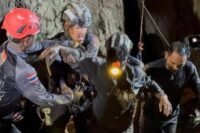
On the afternoon of April 7, 2026, someone finally did. A team of Mexican Army divers, moving through flooded tunnels where visibility was close to zero, caught the flicker of light bouncing off black water. They swam toward it. When they reached him, an officer asked his name and how he was doing.
“Estoy bien,” he answered. I’m well.
His name was Francisco Zapata Nájera. He was 42 years old, and he had been trapped inside a collapsed gold mine in the mountains of Sinaloa, Mexico, for thirteen days. Finding him alive was, by any reasonable measure, close to a miracle — but it was not the end of his ordeal, and it was not the end of the story. Getting him out would take another twenty-one hours. And on the very same day rescuers found him, they would find someone else too — someone who would not be coming home.
Rewind and Setup
El Rosario is a mountainous, rural municipality in the southern part of Sinaloa state, a region better known internationally for its coastline and, less happily, its cartels, but which also carries a long history of small-scale and industrial mining. Gold, silver, and other minerals have been pulled out of these mountains for generations, often by companies working alongside communities that depend on mining jobs with few other economic alternatives.
The mine at the center of this story is called Santa Fe, operated by the company Industrial Minera Sinaloa, tucked into rugged terrain between the small communities of Los Arrayanes and Chele, about nine kilometers from the town of Cacalotán. Like many mines in Mexico, Santa Fe relied on a tailings dam — a engineered structure built to hold back the water, mud, and waste rock left over from the extraction process. Tailings dams are common throughout the mining industry, but they are also one of its most persistent safety risks: when they fail, they don’t leak — they collapse, sending tons of water and sediment crashing into whatever lies beneath them.
On March 25, 2026, twenty-five miners were working inside Santa Fe’s tunnels. It was an ordinary shift, the kind that had likely repeated itself thousands of times in that mountainside. Then, in the early afternoon, the ground and the water around them changed everything.
The Inciting Event
At around 3 p.m., the tailings dam at Santa Fe failed. Investigators would later describe it, in initial statements, simply as a structural failure — the technical cause was still being examined in the weeks that followed. What is certain is what happened next: water, mud, and mining debris surged into the tunnel network, flooding galleries at depths ranging from roughly 150 to 300 meters below the surface.
Of the twenty-five workers inside, twenty-one managed to escape on their own, aided by co-workers and by residents of the surrounding communities who rushed to help. But four men did not make it out. They were somewhere in the darkness below, cut off by rushing water, collapsed passageways, and debris, in a mine that no longer resembled the one they had walked into that morning.
The question that would consume the next month was as simple as it was agonizing: where were they, and were they still alive?
The Investigation
Within hours, Mexican authorities mobilized what would become one of the country’s largest civilian mine-rescue operations in recent memory. A Unified Command Post was set up at the mine entrance, coordinating personnel from the national army (SEDENA), the navy (Semar), the National Civil Protection Coordination (CNPC), the state government of Sinaloa, and even the Federal Electricity Commission, whose engineers helped with the technical work of pumping and drilling. Eventually, close to 400 people from these institutions would be involved in the search.
The first challenge was simply making contact. Rescue teams sealed the point where the dam had failed, to stop more material from pouring in, and began clearing the mine entrance to create a safe way in. At the same time, engineers started a vertical drilling operation, boring straight down through the mountain toward the depths where the miners were believed to be trapped — a technique aimed at both locating them and getting supplies down to them if they were alive. Search teams also prepared to descend through secondary shafts on ropes, rappelling into the flooded galleries.
Five days after the collapse, that effort produced its first breakthrough. Rescuers reached one of the trapped miners, José Alejandro Cástulo Colín, 44, from the town of Angangueo in Michoacán state, and pulled him out alive from a depth of around 300 meters after more than 100 hours underground. It was a jolt of hope for a rescue operation that had, until then, produced only uncertainty.
But hope raised a harder question: if one man had survived nearly five days down there, what about the other three? Were they alive, injured, running out of air or food, waiting for a drill bit or a diver to find them? Or had the same water that trapped them already taken them?
For more than a week after Cástulo Colín’s rescue, there was no answer. Divers pushed further into the flooded tunnels, working in conditions rescuers described as offering essentially zero visibility — feeling their way through submerged passageways by touch as much as sight, while pumps capable of clearing about nine liters of water per second worked around the clock to lower the flood level enough to open new paths forward. Each day without news made the possibility of another survivor feel more remote. And then, on April 7, came the flashlight.
The Twist
By the time the diving team spotted that flicker of light and swam to Francisco Zapata Nájera, it was 1:55 p.m. on April 7 — thirteen days after the collapse. He was alive, standing in waist-deep water, and, based on later accounts from the rescue operation, had survived partly on rations — tinned tuna, energy bars, and water — that rescuers had been able to get down to him. He received basic medical attention on the spot from the dive team.
Here is where the story complicates itself. Finding Zapata alive did not mean getting him out quickly. The path back to the surface ran through unstable, flooded, and in places still-collapsing terrain. Rescue teams spent the better part of a day draining still more water from the route and reinforcing tunnel sections that threatened to give way, all while Zapata waited, alive but still trapped, roughly 300 meters underground. The extraction alone would take nearly twenty-one hours.
Then, on that same day — April 7 — in the middle of an operation that had just delivered its best news in nearly two weeks, rescue teams recovered the body of a third miner. He would later be identified as Abraham Aguilera Aguilera, 33, from the state of Guanajuato. The rescue operation that had just found a survivor was, in the same hours, confirming a death. It’s a jarring detail that captures something true about disasters like this one: relief and grief don’t take turns. They arrive together.
That left one man still unaccounted for, somewhere in a mine that had already taken more than two weeks to yield up its secrets — and there was no way yet to know if he would be found alive, found at all, or not for a long time to come.
The Climax
Francisco Zapata Nájera reached the surface on the morning of April 8, 2026 — nearly fourteen days after the ground had given way beneath him. He emerged wrapped in a thermal blanket, riding out on an electric cart, into applause from a crowd of rescue workers and residents who had gathered at the mine entrance. Medical teams stabilized him — he was dehydrated and weakened but conscious — before he was airlifted by a Mexican Air Force helicopter to a hospital in Mazatlán, about 70 kilometers away, where he was reunited with his family.
Mexican President Claudia Sheinbaum publicly acknowledged the rescue, crediting the Army’s Emergency Response Battalion along with what she described as the miner’s own faith and resilience for making the rescue possible. Asked, underground, how he was doing, Zapata had said simply that he was well; afterward, he would say that throughout the ordeal, he never lost faith.
It was, unambiguously, the high point of the operation — proof that thirteen days trapped in darkness and rising water did not have to end in death. But the operation itself was not over. One man was still missing, and the search for him would go on.
The Aftermath
In the weeks that followed, the story that had briefly become a global news item largely faded from international headlines — but the search did not stop. Crews kept working at the Santa Fe mine site, day and night, hunting for the fourth trapped worker, Leandro Isidro Beltrán Reséndiz, 54, originally from Zimapán, in the state of Hidalgo. Sinaloa’s governor, Rubén Rocha Moya, told reporters in late April that searchers had found fragments of equipment believed to have belonged to Beltrán, evidence that narrowed, without yet answering, the question of where he was.
The answer came on April 27, 2026 — 33 days after the dam first failed. Search teams located Beltrán’s body inside the mine. State prosecutors began the technical and legal procedures required to recover it, and officials said they were maintaining close contact with his family throughout.
With that, the operation that had begun as a rescue effort for four trapped men reached its final outcome: two survivors, two fatalities. What remains far less settled is the question of why the tailings dam failed in the first place — a matter of structural and regulatory investigation that, as of this writing, has not been publicly resolved in detail. Nor is it yet clear whether Industrial Minera Sinaloa or its dam design will face further scrutiny or consequences.
The disaster also landed in a country still reckoning with the safety record of its mining industry. Mexico’s deadliest mining accident remains the 2006 explosion at the Pasta de Conchos coal mine in Coahuila, which killed 65 workers. More recently, in August 2022, ten miners died when the El Pinabete coal mine, also in Coahuila, flooded — a disaster that exposed how many Mexican miners, particularly in smaller or less-regulated operations, work without the safety measures or oversight that might have prevented it. Whether Santa Fe becomes another entry in that pattern, or a case that prompts real change in how tailings dams are inspected and maintained, is a question the coming months and years will have to answer.
For Francisco Zapata Nájera and José Alejandro Cástulo Colín, the two men who came out alive, the ordeal is over. For the families of Abraham Aguilera Aguilera and Leandro Isidro Beltrán Reséndiz, it is not — and for the mountain town of El Rosario, the flashlight in the dark will likely be remembered less as a single miraculous image than as one moment inside a much longer, harder story about what it costs to bring people home from underground.
This account draws on reporting from NPR, The Associated Press, Reuters, Al Jazeera, Fox News, and Mexican outlets including Infobae, La Jornada, and Cambio de Michoacán, current as of late April 2026. Some details of the tailings dam failure’s technical cause remain under investigation and were not fully public at the time of writing.

He Felt the Floor Disappear Beneath Him. Then a Medal That Should Have Been Lost Forever Turned Up in His Pocket.




- Be Respectful
- Stay Relevant
- Stay Positive
- True Feedback
- Encourage Discussion
- Avoid Spamming
- No Fake News
- Don't Copy-Paste
- No Personal Attacks
- Be Respectful
- Stay Relevant
- Stay Positive
- True Feedback
- Encourage Discussion
- Avoid Spamming
- No Fake News
- Don't Copy-Paste
- No Personal Attacks
