Left for Dead on Everest, He Crawled Back to Life: The Impossible Survival of Dawa Sherpa
Published: 22 Jul 2026
For six days, the “death zone” had him. His family had already begun funeral rites. Then a garbage-collection crew spotted a man sliding down the ice toward Base Camp — and everything changed.

On the morning of June 4, 2026, a small cleanup crew was picking its way through the Khumbu Icefall, dismantling ladders and coiling ropes now that Everest’s spring climbing season was over. It was routine, unglamorous work — the kind that happens after the summit photos have already been taken and the world has stopped watching the mountain.
Then someone saw movement in the ice below.
A man was there, sliding and crawling on his own, making his way down through one of the most dangerous stretches of terrain on Earth. He had no rope team, no radio contact, and by then, almost no one left who believed he was still alive.
His name was Dawa Sherpa. Six days earlier, his own family in Kathmandu had begun performing funeral rites for him.
The Incident
Dawa Sherpa, a veteran high-altitude guide from the Okhaldhunga district of Nepal, was working the final stretch of the spring 2026 season on Everest. According to the expedition operator, Himalayan Traverse Adventure, he had been guiding a Polish client on a summit attempt that did not reach the top; the pair turned back and began their descent on May 29 — the last official day of Nepal’s spring climbing season.
Somewhere on the way down, guide and client became separated. Exactly how remains unclear. The client made it safely to Base Camp. Dawa did not.
Reports differ slightly on precisely where he was last seen — some accounts place it near Camp III, around the “Yellow Band” at roughly 7,500 meters (about 24,600 feet); Dawa himself later said the ordeal that trapped him began lower, near Camp 1, around 6,000 meters (about 19,800 feet), where he said he slipped and fell into a crevasse. What is agreed upon is the outcome: as the season wound down and the fixed ladders across the Khumbu Icefall were being taken apart for the year, a lone guide was left high on the mountain with no way down and no one looking for him closely enough, soon enough.
The Timeline
May 29, 2026 — Dawa Sherpa and his client begin their descent from high on Everest after turning back short of the summit. The pair become separated. The client reaches Base Camp safely; Dawa does not.
Late May — With the climbing season officially over, expedition teams begin winding down operations. The fixed ladders through the Khumbu Icefall — essential for any safe crossing — are dismantled.
Days that follow — Dawa has no food, no water, and no supplemental oxygen. He says he survived initially by chewing ice, despite the pain it caused his teeth, and by eating chocolate, biscuits, and dry coffee he found in his jacket pockets.
During this stretch — Dawa falls into a crevasse, by his own account near Camp 1. He describes spending roughly two days trapped inside it, unable to climb its smooth, icy walls. “There was nowhere to go,” he later said. “I would wonder if I would live or die, just hoping that someone would come and rescue me.”
June 3 — A rescue helicopter passes overhead. Dawa hears it but is still inside the crevasse and cannot be seen. “I knew that a helicopter came, I could hear its sound, but could not see it,” he said.
Sometime during his ordeal — An avalanche sends snow into the crevasse, partially filling it and giving him enough of a foothold to climb free. He uses nearby fixed ropes to resume his descent, continuing through the night and surviving at least one more avalanche along the way.
June 4, morning — A cleanup crew from the Sagarmatha Pollution Control Committee (SPCC), the Nepali organization responsible for fixing and later removing ropes and ladders through the Khumbu Icefall, spots him near the base of the icefall, just above Base Camp, at an elevation of roughly 17,999 feet. He is crawling and sliding through the ice on his own.
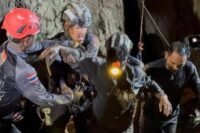
June 4, later that day — Rescuers carry him to Base Camp, where he is given food and water before being airlifted by helicopter to Kathmandu for hospital treatment.
Mid-June — Nepal’s Mountaineering Association visits him in the ICU and calls for a government investigation. His wife files a formal complaint alleging negligence.
June 18–19 — Dawa gives his first detailed interviews, telling BBC Nepali and AFP what he endured. His family confirms he has been moved out of intensive care and continues to recover.
Who Are the Key People?
Dawa Sherpa, also known within the climbing community as “Hillary Dawa” — a nod to Sir Edmund Hillary, who alongside Tenzing Norgay made the first confirmed ascent of Everest in 1953 — is a longtime high-altitude working guide. Different outlets have reported his age as either 52 or 57; that detail has not been consistently confirmed across sources. What is not in dispute is his experience: he is described repeatedly as a veteran of Everest’s most demanding terrain, the kind of guide whose job is to make the mountain survivable for the paying clients he leads.
Damu Sherpa, his wife, had already begun mourning rituals for her husband before learning he was alive. She has since filed formal complaints with both the Nepal Mountaineering Association and Nepal’s Department of Tourism, alleging that repeated requests for a search and rescue effort were ignored, and calling for accountability from those involved in the expedition.
Mendo Lhamu Sherpa, his daughter, has been at his side during his recovery in Kathmandu and has spoken publicly about his condition.
Pemba Sherpa, executive director of 8K Expeditions, which was involved in coordinating search efforts, called the rescue “nothing short of a miracle” and described it as “a true self-rescue” — meaning Dawa largely got himself down the mountain rather than being found and carried from a fixed location.
Lakpa Sherpa, director of the Nepali guiding company 8K Expeditions, said Dawa’s ability to self-rescue was “one of the most incredible things we’ve ever seen on Mount Everest.”
Lama Kazi Sherpa, a member of the SPCC cleanup team, is credited with helping locate Dawa and bring him down to Base Camp.
Billi Bierling, director of the Himalayan Database — the definitive record-keeping organization for Nepal Himalaya ascents — called the outcome “an absolute miracle,” noting Dawa “had no drink, no oxygen, and was probably completely out of steam.”
Ramkrishna Lamichhane, director general of Nepal’s Department of Tourism, confirmed that authorities would investigate the circumstances of Dawa’s abandonment and said the outfitting company could be blacklisted if negligence is established.
The Bigger Context
To understand why this story resonates so deeply in Nepal, it helps to understand the mountain — and the people who make climbing it possible.
Mount Everest, at 29,032 feet, is the highest point on Earth, and its upper reaches sit inside what climbers call the “death zone” — altitudes above roughly 8,000 meters where oxygen is so thin that the human body cannot acclimatize and instead begins slowly dying, even at rest. More than 300 climbers have died on the mountain since climbing records began, and the Khumbu Icefall — a constantly shifting field of towering ice blocks and hidden crevasses that lies between Base Camp and the higher camps — is one of the most dangerous single stretches on the entire route.
Nepali guides, often called Sherpas after the ethnic group from which many of them come, do the most physically demanding and dangerous work on the mountain: fixing ropes, building ladder crossings over crevasses, and carrying supplies up before most foreign clients ever set foot on the route. That labor has come at a steep cost. In April 2014, an avalanche in the Khumbu Icefall killed 16 Nepali guides in a single morning — at the time, the deadliest disaster in Everest’s history — and it triggered a lasting reckoning over pay, insurance, and safety protections for the men whose work underwrites the mountain’s tourism economy.
The 2026 spring season, during which Dawa disappeared, was reportedly one of the busiest on record, with more than 1,000 climbers reaching the summit. Estimates of this season’s death toll vary by source — one count puts it at five fatalities, three of them Nepali guides involved in preparing the route; another count from expedition operators puts the combined toll on Everest and nearby Mount Makalu at seven. That volume of traffic, packed into a short weather window at the end of the season, is part of what made Dawa’s case so alarming to guiding companies: with everyone racing to finish before the ladders came down, a missing guide could be — and reportedly was — deprioritized.
What Investigators, Officials, and Experts Are Saying
Nepal’s Department of Tourism has confirmed it will investigate the case. Director general Ramkrishna Lamichhane has said the government will take “strict action” if shortcomings are found, and that the outfitting company could face blacklisting if negligence is established.
The Nepal Mountaineering Association, the country’s main mountaineering body, has gone further, formally urging the government to establish an independent investigation and to hold accountable “any individuals found responsible for actions that may have endangered the life of a fellow mountaineer.” That call came after Damu Sherpa’s complaint alleged that requests for a search effort were ignored following her husband’s disappearance.
Medical details released by hospital staff describe Dawa being treated for second-degree frostbite on both little fingers, first-degree frostbite on his right thumb and middle finger, severe dehydration, and a fracture near the top of his right thigh bone, close to the knee. Doctors have described his condition as stable and improving, and his family has confirmed he was later moved out of intensive care.
Questions That Remain Unanswered
Several important details of this case remain unconfirmed or disputed between sources, and readers should treat them as open questions rather than settled fact:
- Exactly how and why Dawa became separated from his client during the descent has not been officially explained. The expedition operator has said only that “details of the incident have not yet been confirmed.”
- His exact age has been reported as both 52 and 57 in different outlets, and has not been definitively settled in public reporting.
- The precise location of his fall into the crevasse — whether closer to Camp 1 or higher near Camp III — is described differently across accounts, likely because Dawa’s own recollection, given from a hospital bed after days of extreme exposure, is the primary source for that detail.
- How long the search effort lasted, and how quickly it was scaled back, is central to the negligence complaint filed by his wife, but has not yet been resolved by any official investigation.
- Whether any individuals or the outfitting company will face formal consequences remains to be seen, pending the government’s review.
Public Reaction
News of Dawa’s survival moved quickly through the tightly knit world of Himalayan climbing, where guides, expedition leaders, and record-holders reacted with a mix of disbelief and celebration. Norwegian climber Kristin Harila, who holds the record for summiting all fourteen of the world’s 8,000-meter peaks, called it “fantastic news” and said it was proof that rescue efforts should never be abandoned while there is still hope. Ang Tshering Sherpa, a respected figure in Nepal’s climbing community, told the Associated Press it was “nothing short of a miracle.”
That celebration, though, has run alongside real anger. Multiple outlets have described frustration — from Dawa’s own family and from within the broader guiding community — over how long it took for a serious search to materialize, and over the fact that a veteran guide was left behind at all as the season wound down.
What Happens Next?
Nepal’s Department of Tourism has indicated a formal investigation into the circumstances of Dawa’s disappearance is underway, with the possibility of certification suspensions or blacklisting for the outfitting company if negligence is found. The Nepal Mountaineering Association has asked for that process to be independent of the companies involved. Dawa’s wife has requested compensation as part of her complaint. None of these processes had produced a public resolution as of the most recent reporting.
Dawa himself, meanwhile, has said his days of working as a high-altitude climbing guide are over. “I will not go to the mountains now,” he told reporters from his hospital bed, “maybe just for some trekking.”
Conclusion
Strip away the extraordinary details — the chocolate melted for calories, the ice chewed for water, the avalanche that, improbably, became his way out of a crevasse — and what’s left is a much older story about Everest: the mountain rewards very little and forgives even less, and the people who make it climbable for others are often the ones most exposed when something goes wrong.
Dawa Sherpa’s survival is being celebrated, rightly, as an extraordinary act of will. But the questions his wife and Nepal’s mountaineering association are now asking — about how quickly he was searched for, and why he was left behind at all — may end up mattering just as much as the miracle itself.



- Be Respectful
- Stay Relevant
- Stay Positive
- True Feedback
- Encourage Discussion
- Avoid Spamming
- No Fake News
- Don't Copy-Paste
- No Personal Attacks
- Be Respectful
- Stay Relevant
- Stay Positive
- True Feedback
- Encourage Discussion
- Avoid Spamming
- No Fake News
- Don't Copy-Paste
- No Personal Attacks
